Hi, I'm
Samarth Mahendra
Software engineer building reliable backend systems and thoughtful product experiences.
From the interface to the infrastructure, I care about how software feels, performs, and holds up at scale.
Hi, I'm
Software engineer building reliable backend systems and thoughtful product experiences.
From the interface to the infrastructure, I care about how software feels, performs, and holds up at scale.
The stack I build with
Where I've built
A small look at the habits I keep up consistently: practice, shipping, and staying close to the work over time.
I care about the full arc of engineering work, from how a product feels to how the underlying systems perform under real load.
I’m drawn to engineering problems that sit between product needs and system behavior, where the work is not just about shipping a feature, but about making sure the underlying design will continue to hold as things grow. That usually means backend services, APIs, data-heavy systems, and the kinds of debugging and performance work that reveal where the real bottlenecks are.
What motivates me most is being able to move comfortably across layers of a system without treating them as separate worlds. I enjoy building product-facing software, but I’m equally interested in the platform and infrastructure decisions underneath it: how data moves, where latency comes from, how systems fail, and what makes them easier to operate. I think that mix of product awareness and systems curiosity is where I do my best work.
At this stage, I want the site to show breadth without sounding generic. I can work across a lot of areas, but my strongest edge is in backend and systems-oriented engineering, especially when the problem requires learning quickly, reasoning deeply, and contributing to real production-quality work.
MS in Computer Science (Jan 2024 – Dec 2025)
Coursework: Programming Design Paradigms, Algorithms, NLP/ML, Database Systems, Mobile Development, Computer Systems, Software Engineering
BE in Computer Science (Aug 2018 – Jul 2022)
Regular attendee and part of a great local builder community centered around side projects, conversations, and code.
Active participant in Boston-area AI and ML meetups, following how agents and LLM systems are moving into real products.
I care less about collecting tools and more about knowing where they matter: which abstractions hold up in production, which ones fall apart, and how to move comfortably from feature work into system behavior.
I like the kinds of engineering problems where architecture, debugging, runtime behavior, and developer velocity all intersect. That usually means backend services, data-heavy systems, migrations, performance work, and the glue that keeps teams shipping.
Translate product or systems ambiguity into something buildable.
Design APIs, pipelines, and storage paths that stay reliable under growth.
Profile, debug, and simplify systems when the real bottleneck appears.
From shipping backend features at scale to studying system behavior more deeply, each role strengthened how I design, debug, and deliver software.
Amazon Web Services · Seattle, WA
Software Development Engineer on AWS Identity and Access Management (IAM), the service that controls who can access what across AWS.
Cyber Security and Privacy Institute · Northeastern University
Designed and scaled robust server-side IoT infrastructure (Testbed) under the NSF-funded SPHERE project, focusing on secure, high-performance networking protocols and resilient systems execution.
Prof. Xiang (Jenny) Ren · Khoury College of Computer Sciences, Northeastern University
Contributing to systems research focused on automated performance debugging, bringing a production engineering lens to profiling, bottleneck analysis, and runtime behavior.
Draup · Bengaluru, India
Worked on a customer-facing intelligence platform, owning backend systems, query infrastructure, API migrations, and observability improvements across business-critical product surfaces.
Draup · Bengaluru, India
Focused on the fundamentals that make engineering teams faster: caching, observability, and internal knowledge-sharing. This is where I built strong instincts for operational quality and practical performance wins.
Dayananda Sagar College of Engineering
Built tooling and algorithms for myocardium wall motion and wall thickness mapping from MRI data, combining image processing, domain-specific modeling, and serious optimization work to handle large high-resolution DICOM workloads.
I use writing to make technical ideas clearer, especially where performance, architecture, and implementation details quietly shape outcomes.
A regression deep dive showing how descending TTL indexes in MongoDB 4.4 became nearly 57% slower, why WiredTiger was zigzagging with redundant cursor probes, and how a small direction-aware patch fixed it.
Read essayA ground-up look at B-Trees, LSM trees, WALs, and the choices that separate fast databases from fragile ones.
Read essayHow modern lakehouses handle file selection and query planning at scale, and why naive approaches break once the number of files becomes the real systems problem.

Read essayI usually write about systems where hidden implementation details determine performance, reliability, or product feel.
The projects below are the strongest signals for how I build: distributed runtimes, storage and data systems, cloud-backed infra, real-time AI workflows, and product experiments with clear user feel.
An Ableton Live 12 extension that brings GPT-powered MIDI generation, editing, and arrangement directly into the right-click menu. It reads the full session — tempo, key, every track, drum-rack pad map — then writes musically aware drums, basslines, and melodies that lock to what's already playing.
[AI Copilot] loaded with gpt-5.2 — right-click any clip
read session: 124 BPM · F# minor · 6 tracks
set_drum_pattern → 64 notes locked across 8 bars
validators → scale-snapped 2, humanized velocities
A task runtime and scheduler built to explore futures, object references, and distributed worker execution over a layered architecture with gRPC-backed coordination.
worker-1 accepted task graph
future<dataset> mapped across distributed nodes
object-ref resolved with scheduler handoff
throughput tuned around task-based execution
A cloud-native ingestion platform for collecting, classifying, and analyzing job postings at scale, built around queue-driven workers, resilient browser automation, and production observability.
Two systems-heavy projects around data access paths: one for persistent key-value storage with WAL and locking, and one for efficient file pruning over large analytical datasets.
A live AI interaction loop built around FastAPI, Redis, Twilio, Celery, and multiple model providers, designed to make voice and chat feel fast, contextual, and production-ready.

A serving platform for transformer inference using FastAPI, Docker Compose, and NVIDIA Triton, built to explore deployment flow, ONNX conversion, and dependable model delivery on cloud infrastructure.
gateway routed embedding request
triton server loaded ONNX model
compose healthcheck passed on redeploy
remote deploy triggered from GitHub Actions
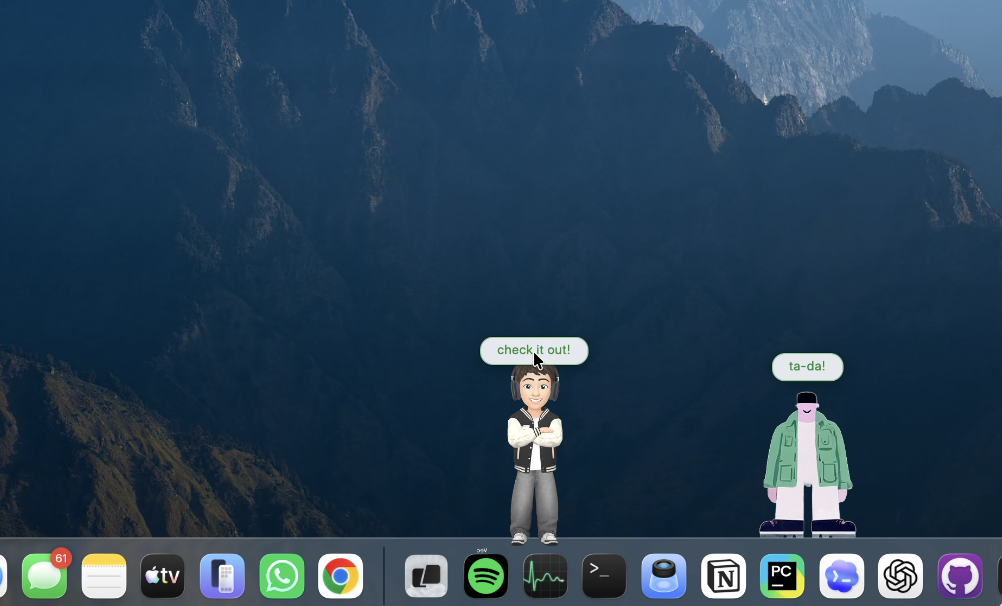
A personalized fork of the open-source lil agents project, rebuilt around custom Bitmoji characters so the assistant feels playful without losing utility.
Additional builds that still matter, but don’t need full case-study treatment here.
I’m currently open to software engineering opportunities where I can contribute across backend architecture, systems thinking, and product-facing delivery.
Whether it’s a backend role, a systems-heavy product team, or simply a conversation about engineering, I’m always happy to connect.
Three font directions that all fit the layout, but each sends a slightly different signal.